Yoshiyuki Okuyama, photographs
KYOTO: AKAAKA, 2026
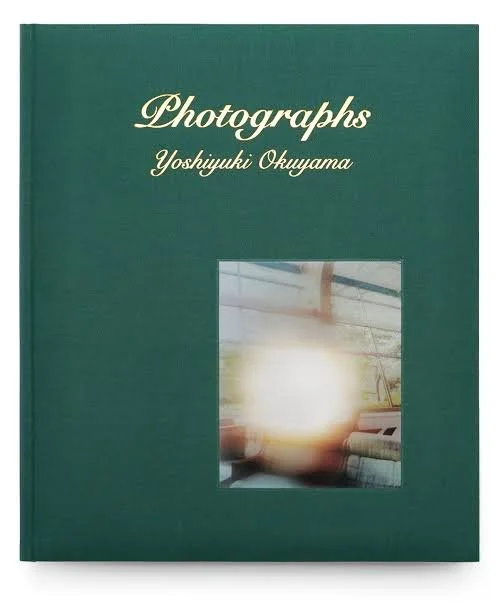
For Yoshiyuki Okuyama’s book photographs—the final chapter in a trilogy including flowers (2021) and windows (2023), exploring the exchange of the gaze—I contributed the essay “Inner Light”, discussing Okuyama’s deeply personal and experimental take on the vernacular object that is the family photo album. An excerpt of this essay is available below:
The seed for this series was first planted when he discovered a collection of over one hundred family photo albums that had been stashed away in a closet in his grandmother’s home. This is a remarkable archive by any standards, one that must have felt all the more monumental for him as, following his grandmother’s passing, Okuyama had decided to set up his photographic studio in her home. As he leafed through these albums, a sense of continuity and lineage came to the fore. Okuyama was conflicted, both grateful for the generations before him whose decisions led to his very existence today and overwhelmed by the obligation of extending that lineage. He recalls, “I felt a certain kind of pressure—so strong that it almost felt miraculous—that I must somehow carry this ‘family’ forward into the future. It was this coexistence of gratitude and pressure—this mixture of conflicting emotions—that led me to create the work.”
The decision to use this collection of albums as the basis for an artistic project is an unusual one in the context of Japanese photography. In the West, the last two decades have seen an explosion in projects that draw on archives—whether the photographer’s own or images that they have found or appropriated—but that practice remains far less common in Japan. While the rise in archival work is understandable in the context of a world that is drowning in images, I have often struggled with the premise upon which personal archive projects are based. These are images that are uniquely significant to the artist, full of biographical meaning, but to which the external viewer has no relationship at all. How can the profound significance of such an inherently personal object successfully translate into the far more open and broad space of art?
For photographs, Okuyama developed a protocol that allowed him to move from the concrete to the abstract by simply redacting the people that appear in those photographs he selected from the recovered albums. In each scene, the figures that would normally occupy centre stage have been replaced by a luminous glow that imbues these everyday images with an otherworldly quality. There is something undeniably phantomatic about the results, but the overriding sense they convey is not of the morbid or of the sinister, but rather the elegiac or the transcendent. It is precisely the sense of the miraculous which Okuyama felt upon discovering these albums that is conveyed through his interpretation of these photographs. The light that emanates from each of these silhouettes gives these images a certain magical power, as if they are no longer fixed memories, but organisms endowed with some form of life.
In fact, redact is perhaps the wrong term here. Okuyama is not so much obscuring or obstructing something from view, but rather sublimating these everyday scenes into something more universal and open to possibility. By literally removing the personal—the word derives from the Latin personalis meaning “of a person”—Okuyama does not really disrupt the simple vernacular language of the photographs. Instead, he makes it possible for us to project our own stories into these spaces, allowing us to imagine ourselves and our own families sitting around that crowded dinner table or standing beneath that cherry blossom tree.
This visual device not only gives the external viewer access into this otherwise impenetrable private space, but it also enabled Okuyama to free himself from the weight of his own family history. As the faces of his relatives dissolve into light, the specifics of these relationships—good or bad, close or distant—are replaced by a more universal sense of the individual and the collective.
photographs is a different kind of family album, one that expresses the universal quality of this storytelling object. Boundaries dissolve between the individual and the collective, the personal and the universal, the viewer and subject. Yoshiyuki Okuyama celebrates the unique power of the album by honouring the specific moments contained within his own family photographs while also inviting us—and perhaps himself also—to continue adding to and sharing the stories that make us human.