Ryudai Takano, Kasubaba 2011–2020
TOKYO: BOOKEND PUBLISHING, 2025
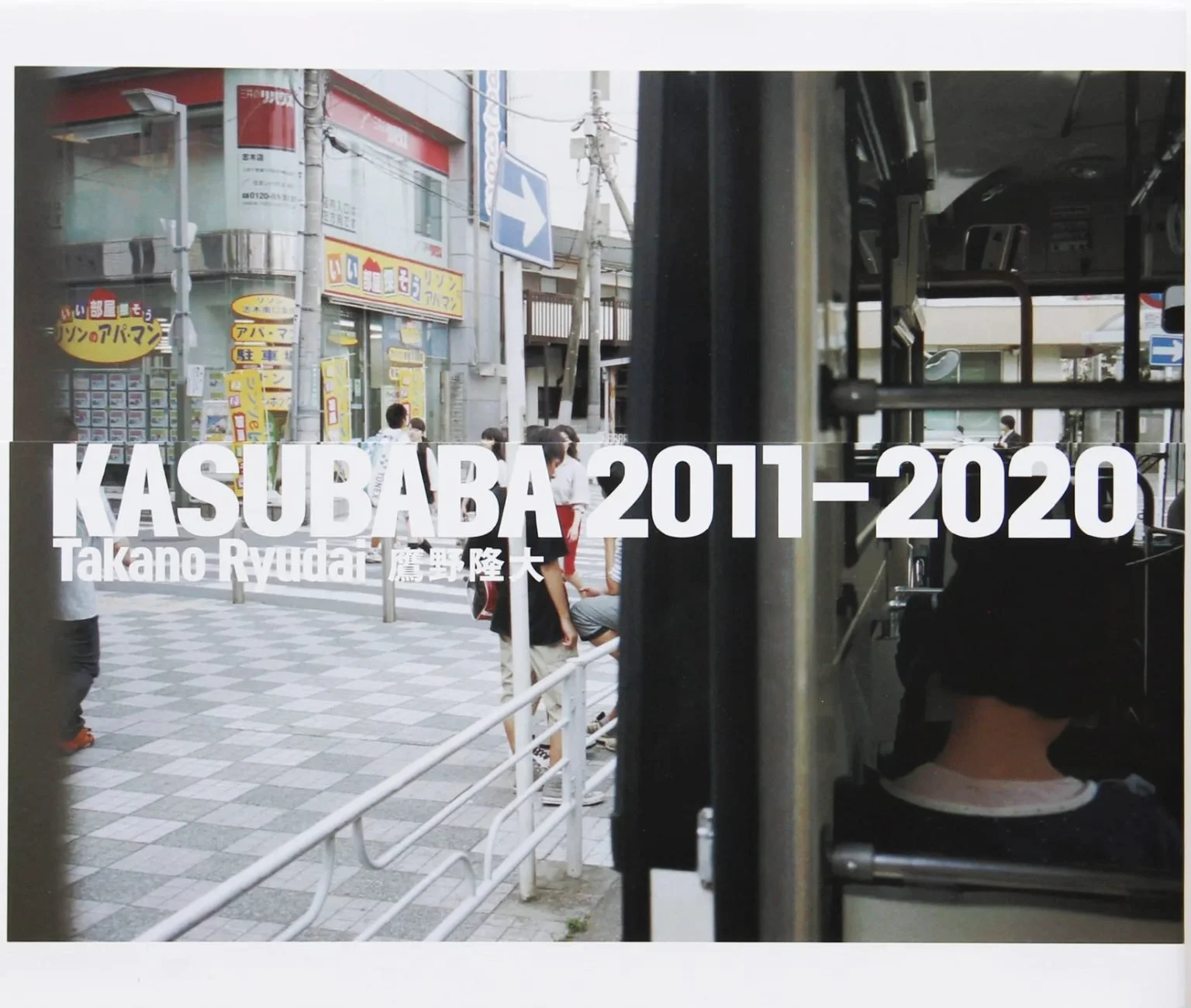
For Ryudai Takano’s latest collection from his kasubaba series, published in conjunction with his retrospective at TOP museum in Tokyo, I contributed an essay, “An Ode to the Overlooked”, looking at how his streetscape practice has evolved into a kind of photographic mindfulness. You can read an extract below:
The series Kasubaba from which this book is drawn stems from a daily photographic practice entitled Daily Snapshots which Takano began in 1998. “I started this series in order to make my act of photographing an everyday happening,” he explains, “and try to regard a camera as part of my body.” Kasubaba was one of several projects to emerge from these Daily Snapshots and the looseness and detachment of the photographs collected here speak to Takano’s approach in making these images. Neither artful nor artless, neither composed nor deliberately anti-compositional, they seem to be the photographic equivalent of mindfulness: made with the body and not with the mind.
The term kasubaba is a neologism, a composite word that Takano created by combining the term kasu (which can be translated as junk) with ba (place)—the repetition of ba acting as a pluralisation of the term. The idea of a “junkscape” is an immediately evocative one, familiar to any city dweller the world over. Our cities are all full of spaces that seem so painfully uninteresting or unattractive that we instinctively toss them into the wastebin of our gaze, filtering them out so that we waste as little of our attention on them as possible.
As is often the case with the Japanese language, it is difficult to settle on a perfect translation of the composite term kasubaba and I have found myself wondering if we should really think of these as junkspaces. Kasu can have the connotation of something discarded or leftover rather than outright junk or trash. With this second book, it seems as if Takano’s own conception is moving away from a more critical view of these spaces to one that steers clear of any judgement, casting a softer, even redemptory gaze upon them. This may be a stretch, but I cannot help but see a burgeoning affection in this new series of “kasubascapes.” Perhaps it is the warmth conferred by the 35 mm film camera Takano has used throughout the series or the absolute ease that he now appears to have in making these images.
Kasubaba can be read as an attempt to reconsider which landscapes we choose to pay attention to (as opposed to those which frequently appear in our field of vision). The experience of leafing through the pages of this book is akin to that of wandering aimlessly around a city, seemingly always travelling between an unknown (and irrelevant) point of departure and destination. Many of these images are made at those points where the city requires us to stop: waiting for a light to change at an intersection, a train to pass at a railway crossing, or for a friend to arrive outside a subway station. These are spaces of urban function, rather than those we might choose to stop and admire or indeed those we might actively avoid passing through. As such, they are a kind of collection of enforced urban views, the cityscapes that we are confronted with, often in a repetitive pattern dictated by our codified movements through the city.